


 September 30, 2026
 September 7, 2026
Japan Storage Warehouse
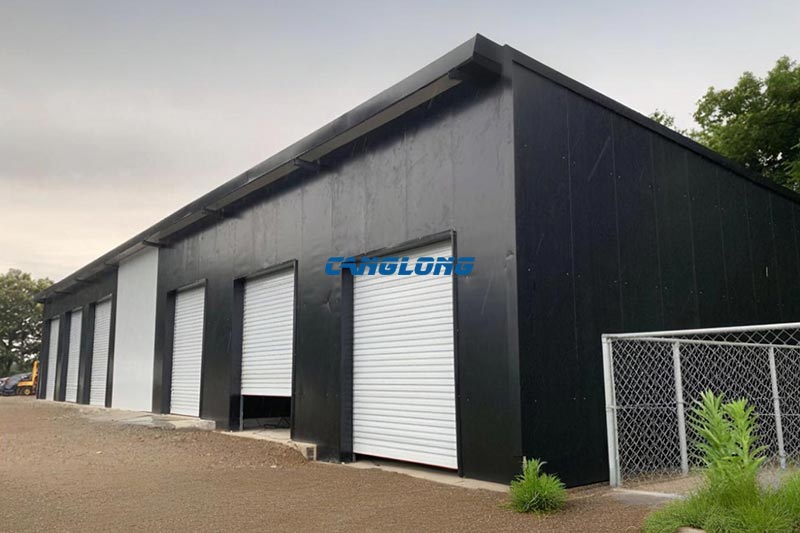
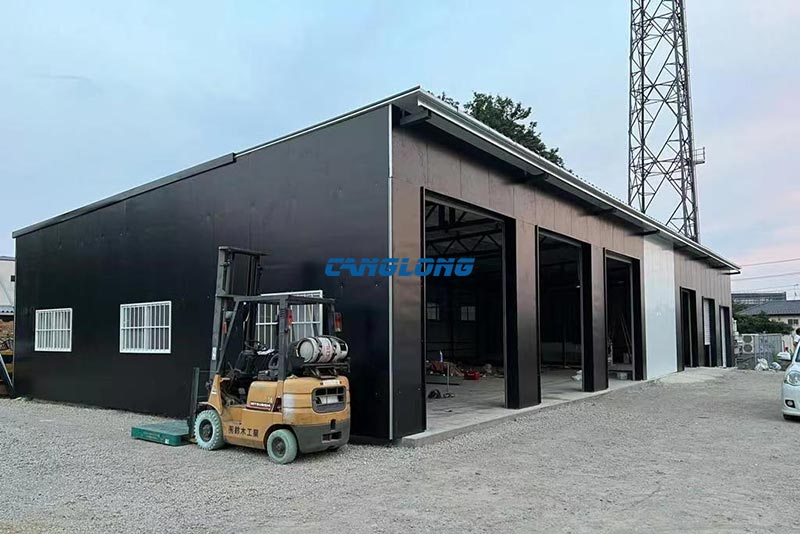
A storage warehouse in Yokohama does not need to say much. This one — 28 × 11.4 m on plan, a single plane of black cladding falling from a 4.9 m high eave down to a low rear wall — is a good example of a small industrial building that gets its specification exactly right and stops spending there. Canglong Group supplied the complete kit in 2022: steel structure, the 50 mm EPS sandwich panels for roof and walls, roller doors, windows, internal partitions and the lighting, so the building went from container to working storage in one sequence.
Small warehouses are where envelope decisions show up most clearly in the final bill, because the building is too small to amortise an over-specified shell. This page walks through the three decisions that shaped it — one roof slope instead of two, 50 mm of insulation instead of more, and black cladding instead of grey — and what each one bought the client.
| Location | Yokohama, Kanagawa, Japan |
| Use | General goods storage |
| Dimensions | 28 × 11.4 m, high eave 4.9 m |
| Floor area | approx. 320 m² |
| Roof form | Single slope (mono-pitch) |
| Envelope | 50 mm EPS sandwich panels, walls and roof, black |
| Supplied | Steel frame, panels, roller doors, windows, internal partitions, lighting |
| Completed | 2022 |
One Roof Plane, One Gutter Line
The defining choice here is the roof: a single plane falling across the full 11.4 m width, high wall over the door elevation, low wall at the back boundary. On a building this size, that geometry earns its keep in four quiet ways.
First, drainage. All the roof water lands in one gutter on one side of the building, running to one set of downpipes. Kanagawa sits squarely in the typhoon belt, and the hours that test a warehouse roof are the hours of maximum rainfall intensity — a single-slope roof concentrates that work at one detail the erector builds once and the owner maintains in one place, instead of splitting it across a ridge and two eaves.
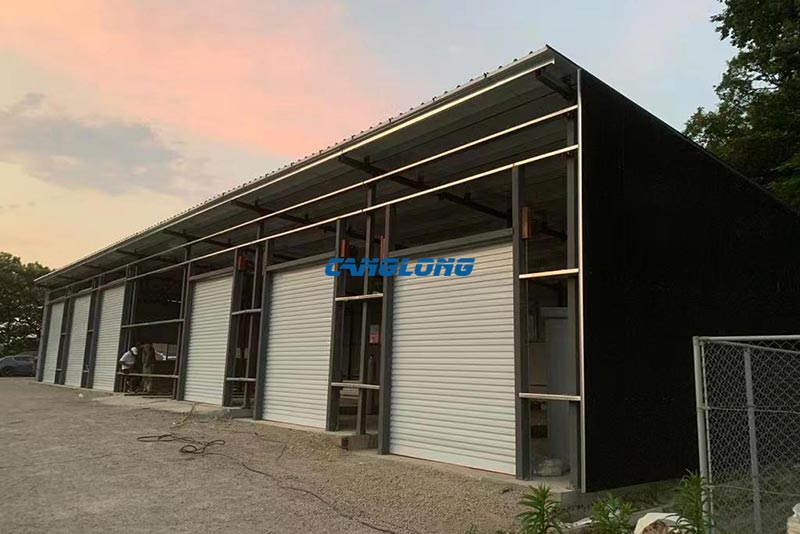
Second, structure. An 11.4 m span is light work for a mono-pitch portal. The rafters are simple sloping beams without the ridge connection a double-slope roof needs, which trims fabrication time and makes the frame easier to stand plumb — visible in the installation photos, where the frames went up in a matter of days.
Third, the boundary. The low wall faces whatever is behind the plot, so the building presents its working face — the tall door wall — to the access side and steps down quietly toward the neighbours. On the crowded plots around Yokohama Bay, a building that avoids arguing with its neighbours over height and shadow is a building that gets approved and built without friction.
Fourth, volume where it is useful. The tall side is the side with the doors, so forklifts and racking get the full 4.9 m exactly where pallets move, and the section of roof that nobody works under is the cheap, low one.
One Panel Doing Two Jobs: 50 mm EPS on Walls and Roof
Roof and walls use the same panel — a 50 mm EPS-cored sandwich sheet — in the same colour, on the same fixing grid. That single-system decision is worth unpacking, because it is the difference between a building ordered and a building coordinated.
On thickness: 50 mm is the honest specification for a general storage building in the Kantō climate — hot, humid summers, winters cold enough to notice but not to design around. Stored goods here are not temperature-critical; the insulation exists to keep the interior from becoming an oven in August and to limit condensation on the underside of the roof when humid air meets a cool sheet. Beyond that job, every additional millimetre is money the building does not return. The envelope should always be sized to the use: our cold store in Chile carries 200 mm polyurethane because the product is frozen; our cashew plant in Tanzania deliberately uses no insulation at all because the process generates heat. This warehouse sits between those two extremes, and 50 mm is what sitting between them looks like.
On using one panel everywhere: one part number for the entire envelope means one production run, one delivery batch, one detail for the fixers to learn, and no transitional flashings where two systems would have met at the eave. When a panel is damaged years from now, the replacement is stocked and known. Simplicity is a maintenance decision as much as a construction one.
Black on Purpose
The client chose black for both roof and walls, and it is worth saying plainly what that choice does and does not cost. What it does: a deep, uniform envelope that reads as a single mass rather than a shed with panels on it, and ages well in a coastal-industrial streetscape where dust and weather would streak a lighter façade unevenly. What it does not do: reflect the summer sun. A black roof runs hotter than a grey one; on this building that penalty is modest, because the conditioned expectation is modest — the 50 mm core plus the air volume under the high side keeps the working zone usable. For a warehouse with office space inside or any strongly air-conditioned use, we would counsel lighter roof colours and put the black on the walls. Colour is a specification, not a decoration, and it belongs in the drawing stage — which is where this one was decided.
A Complete Building, Not a Frame Kit
The supply scope on this project is the part many first-time steel buyers underrate. Alongside the frames and panels, Canglong shipped the roller shutter doors for the front wall, the windows, the internal partition walls that divide the storage bays from each other, and the lighting for the interior. The building arrived as one coordinated set: openings cut to fit the doors that were coming, panel joints running to the window positions, partitions fixed to a frame designed to receive them.
The alternative — buying the steel from one supplier, sourcing panels locally and leaving doors, windows and fit-out to be negotiated on site — is how small warehouse projects lose their schedule: not in fabrication, but in the weeks between components arriving that were never dimensioned against each other. A single source that ships the whole building carries that coordination risk internally, where it costs nothing, instead of handing it to a site crew in Yokohama. Steel’s light dead weight is also the quiet advantage in a seismic region: the less mass a structure has to accelerate in an earthquake, the smaller the forces its connections must resist.
Shipped as One Sequence, in 2022
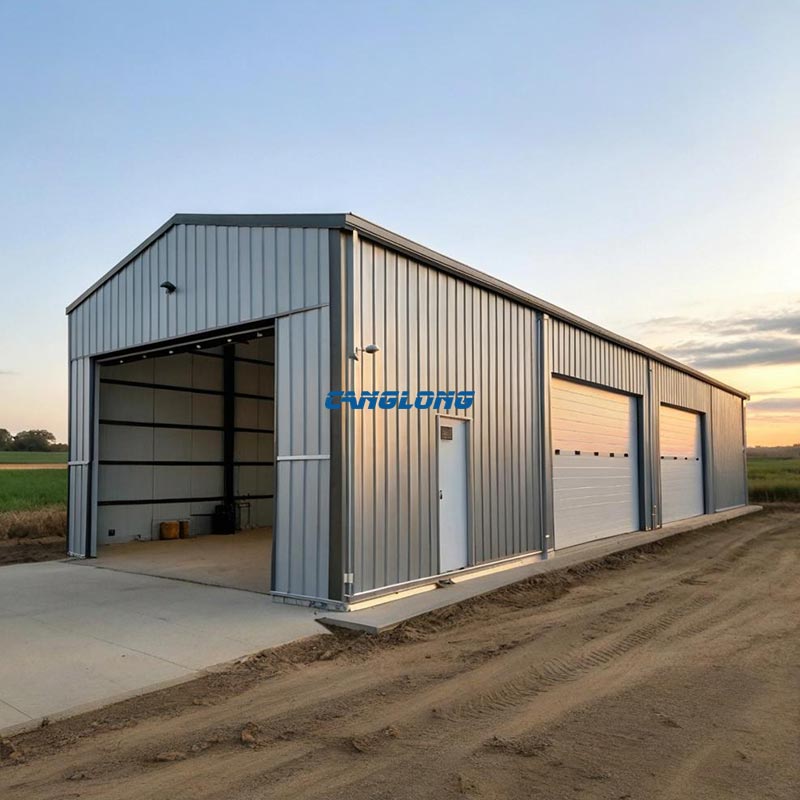
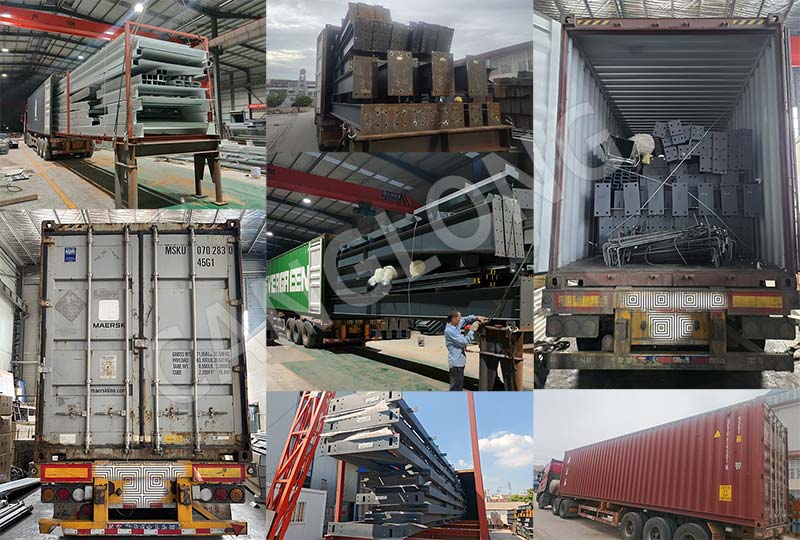
The full kit — frames, panels, doors, windows, partitions and lighting — left in standard containers packed in erection order, cleared port, and the building was erected and closed in during 2022. The dusk photo above was taken mid-erection: frames standing, wall panels climbing, door openings waiting for shutters that were already on site. That is what a coordinated kit looks like from the erector’s side — nothing arrives that needs altering before it fits.
When a Mono-Pitch Is the Wrong Answer
For honesty’s sake: single-slope roofs stop making sense before most buyers expect. Past roughly 15–20 m of span, the tall wall gets tall enough to cost more than a ridge saves, the racking section at the high end grows disproportionately, and a double-slope frame carries the same width more cheaply — which is why most of the warehouses in our project portfolio are gabled. Heavy snow regions also push toward steeper, symmetric roofs. This building sits comfortably inside mono-pitch territory at 11.4 m, in a climate where snow is a nuisance rather than a design case. Matching roof form to span and climate — rather than to whatever the brochure shows — is most of the engineering on a building this size. If your span sits in the same range, our single slope warehouse page covers the system in detail.
If you are planning a storage building in Japan or anywhere with tight plots, typhoon rain and a seismic code, send us the plot and the storage plan. The useful conversation starts with what the building stores — the roof form, panel thickness and colour all follow from that.
Project Info
Country
Japan

Project Name
Storage Warehouse
Project Date
2022-7-9
Product Address
Chiba Prefecture, Honshu Island
Area
540㎡
Customer Reviews
10.612 Rating
Quality
4.9
Price
4
Design
88
Service
91
Delivery
83
Package
75
Project Details
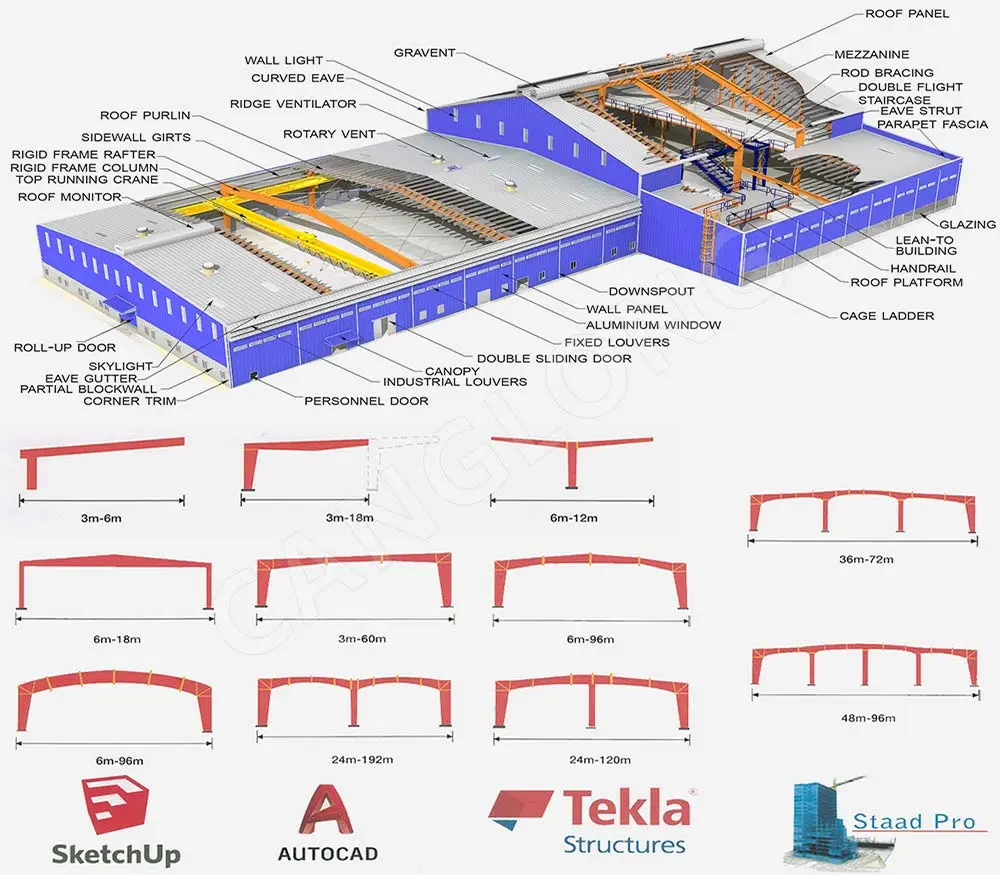
The warehouse building adopts an efficient and practical single slope roof structure design, with a simple and modern shape, which is not only conducive to rapid drainage, but also gives the building a unique visual tension. The main structure adopts sturdy Q235 material H-shaped steel as beams and columns, ensuring the excellent stability and bearing capacity of the overall frame, and guaranteeing the safety of long-term use.
The enclosure system uses high-performance polyurethane insulation boards as roof and wall materials. This board integrates insulation, thermal insulation, fire prevention, and decorative functions, effectively maintaining stable temperature inside the warehouse, significantly reducing energy consumption, and creating an efficient and energy-saving storage environment for customers. All entrances and exits are equipped with sturdy and durable industrial roller shutter doors, which are easy to open and close, safe and reliable.
No
Contact us Leave a Message
Your email address will not be published. Required fields are marked *
Bringing the steel building to you
Figure out what you want, choose the type of building you need, understand the cost, contact Canglong then go get it!