 2026-09-20
By
 Canglong Group
24
Steel Structure Fabrication Quality Control: What We Show Buyers on Our Shop Floor
Most buyers comparing steel warehouse quotations never see the factory that will build their frames. They compare tonnage, price per square metre and a delivery date. Two quotations can look nearly identical on paper and still behave very differently in year ten, because the difference was decided on a shop floor nobody walked.
We have started running factory visits differently. Instead of starting clients in the finished-goods area, we now start them at the raw steel and walk the line in production order, ending where the containers are loaded. This post is that walk, written down: eight stages, what each one decides about your building, and the specific things we stop and point at.
Use it two ways. Read it as background for your own portal frame warehouse project, or print it and take it to any fabrication plant you audit — including ours. A supplier who is uncomfortable with this checklist is telling you something.
Why We Wrote This Instead of Another Product Page
Our engineering guide to portal frame structures lists the standard fabrication sequence and tells buyers to ask manufacturers what welding procedures and inspection requirements apply. That question is usually left hanging, because the honest answer is long and factory-specific. This post is our answer.
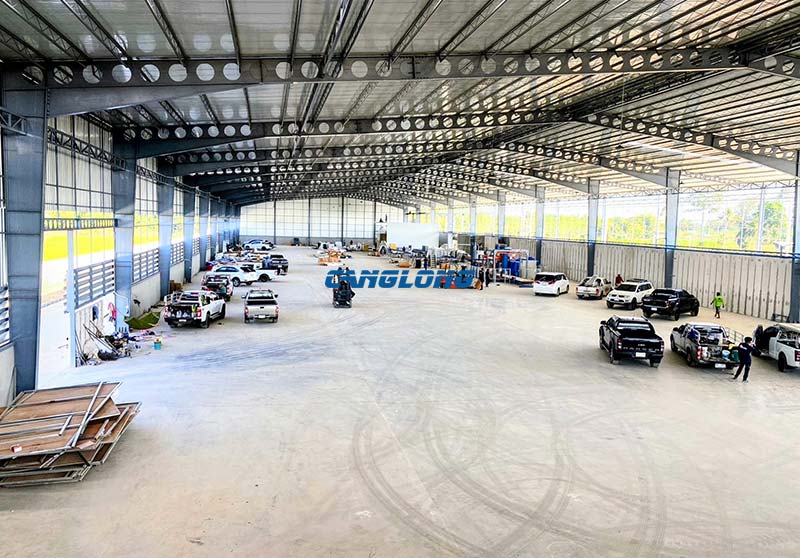
Everything described below happens inside our own production park — engineering, cutting, welding, surface treatment and packing on one site, inside a single 100,000 m² production park. None of it is a trade secret. If a competitor copies it, their clients get better buildings, which is fine with us.
The Line at a Glance
| Stage | What it decides | What we check and show |
|---|---|---|
| 1. Raw material intake | Steel grade, traceability | Mill stencil and heat number matched to MTC |
| 2. Cutting | Dimensional accuracy, edge quality | Machine program vs shop drawing; slag-free edges |
| 3. Fit-up and assembly | Weld quality downstream | Alignment and tack welds before full welding |
| 4. Submerged arc welding | Strength of frame connections | Penetration, weld grade, consumable certificates |
| 5. Straightening | Verticality and camber | Post-weld distortion corrected, not tolerated |
| 6. Pre-assembly | Erection speed on site | Numbered plates checked against erection drawings |
| 7. Blasting and painting | Coating life | Blast profile, DFT per coat, masked faying surfaces |
| 8. Packing and loading | Condition on arrival | Packing racks, loading video |
Stage 1: Steel That Still Carries Its Mill Stencil
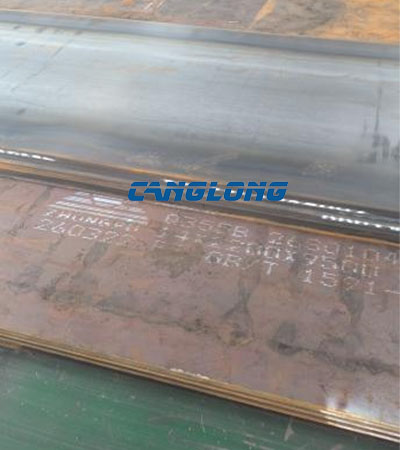
The first thing we show a visitor is not a machine. It is a plate.
Every plate arrives from the mill with a stencil: grade, heat number, dimensions. We keep that identity all the way to the cutting table. Ask for the Mill Test Certificate and you get EN 10204 3.1 documents in which each heat number matches plates you can still walk up to and read on the floor.
Our frames default to Q355B — the equivalent of S355 — for primary members, with Q235 reserved for secondary steel where the loads do not justify the upgrade. If a quotation does not state the grade for each member type, ask why not.
Stage 2: Two Cutting Lines — and Why Your Lead Time Starts at a Drawing
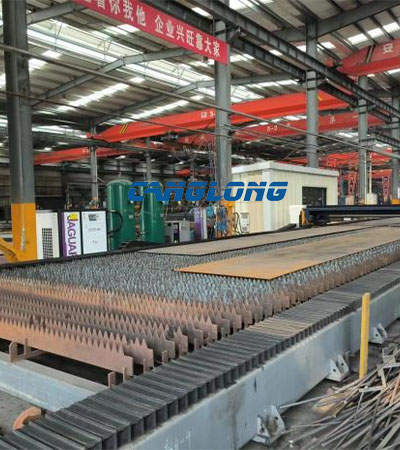
Just inside the workshop door, two cutting lines sit side by side: a fiber laser machine on the left, an older gantry flame cutter on the right. Both stay busy, and the division of labour between them matters more than either machine alone.
Connection plates, gussets and anything with holes go to the laser. The edge comes off slag-free, with no secondary grinding, and each part leaves the table carrying its own number. Heavier plate, where a slightly rougher cut edge is acceptable, goes to the flame cutter — which still works from manually struck layout lines, so it gets the jobs where that does not matter.
Two things about this stage surprise buyers.
First, lead time. The cutting machine is rarely the bottleneck. Engineering has to produce shop drawings and convert them into machine programs before the first plate is cut. When we quote a delivery date, a large part of it is decided at a desk, not at a machine.
Second, the tonnage basis. Cutting a frame set from stock plate always produces kerf and offcuts, so steel counted on the shop drawings and steel counted on a weighbridge are two different numbers. Agree which basis the contract uses before you sign — it is one of the most common reasons a final settlement looks nothing like the original quotation.
Stage 3: Fit-Up — Fixing Distortion Before It Becomes a Weld Defect
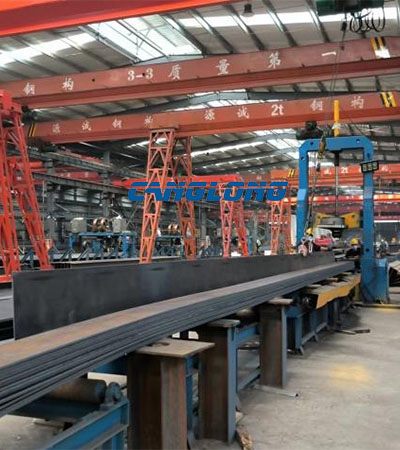
Cutting heats steel, and heated steel moves. By the time a flange and web reach the assembly machine they are rarely perfectly straight, so fitters tack-weld the section together, checking alignment and correcting geometry by hand as they go.
The point we make to visitors here: weld quality is largely decided before a welder arrives. A poor fit-up cannot be rescued by a good welding machine. The same line also assembles box columns for multi-storey projects, but that is a different conversation.
Stage 4: Submerged Arc Welding — the Weld You Have to Squat Down to See
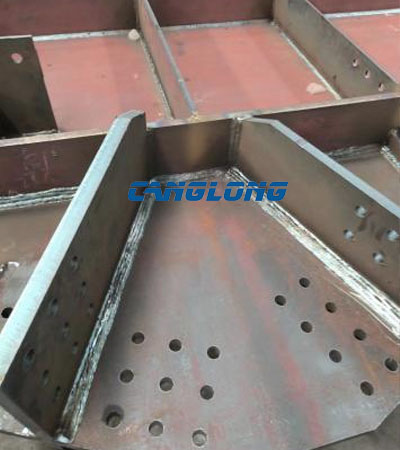
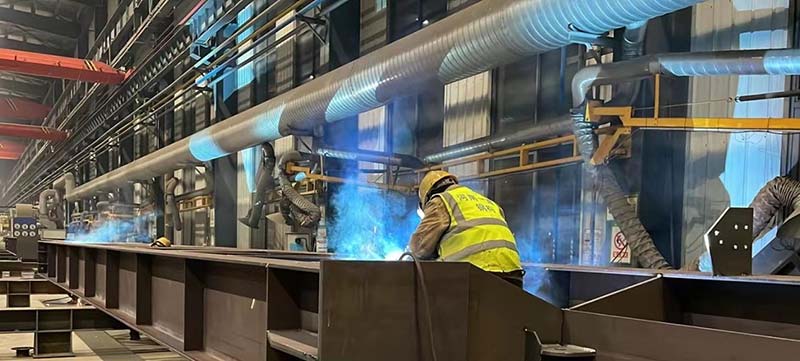
When we walk clients through this station, we ask them to squat down and look at the underside of the flange. That is where the case for a properly equipped shop is visible.
The flange-to-web welds run through an automatic submerged arc welding gantry. A granular flux blanket covers the arc, so the weld metal cools slowly and cleanly: deep, consistent penetration with none of the spatter of manual work. The underside shows a continuous, even bead — a full-penetration weld.
Weld grade is a specification, not a default. Standard production delivers sound, code-compliant welds; where a project requires first-grade, verified full-penetration welds, it must be written into the order. The machine runs slower and some joints are finished and dressed by certified welders, so the weld is wider and the cost is higher. Say it at order stage, not after delivery.
The consumables matter too. The submerged arc flux and wire come from certified mills, and batch certificates are available on request. If a supplier cannot produce them, ask what is actually going through the machine.
Stage 5: Straightening — the Unphotogenic Machine That Keeps Your Columns Vertical
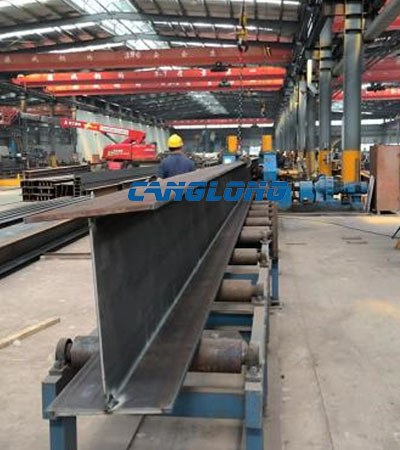
Welding shrinks steel. Even with a good fit-up, an H-section coming out of the welding gantry is rarely perfectly straight, so it passes through a correction machine that presses flange and web back true.
This is the least dramatic machine on the line and one of the most important. Columns that leave the shop out of vertical do not fail dramatically on site; they just turn every splice and every bolted connection into a fight, and the erection schedule pays for it.
Stage 6: Pre-Assembly — Numbered Plates You Can Check Against Your Own Drawings
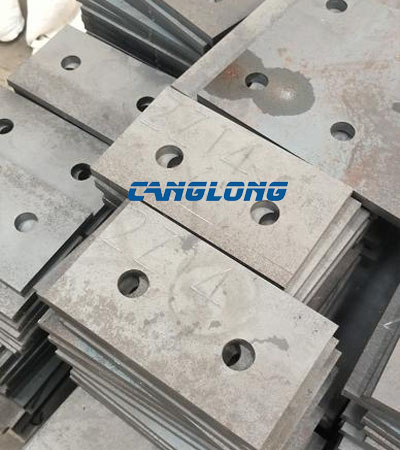
Before surface treatment, frames are pre-assembled with their connection plates. Every plate is laser cut — no slag, no hand rework — and carries its own part number. A client standing in the shop can pick up a plate and match it to the erection drawing. On site, the same thing happens: each plate corresponds to a drawing reference, so the erection crew is matching numbers rather than improvising.
Two details worth checking in any shop:
- Base plates carry welded shear keys. The small block welded between plate and column transfers shear into the foundation, so the anchor bolts are not doing a job they were never sized for.
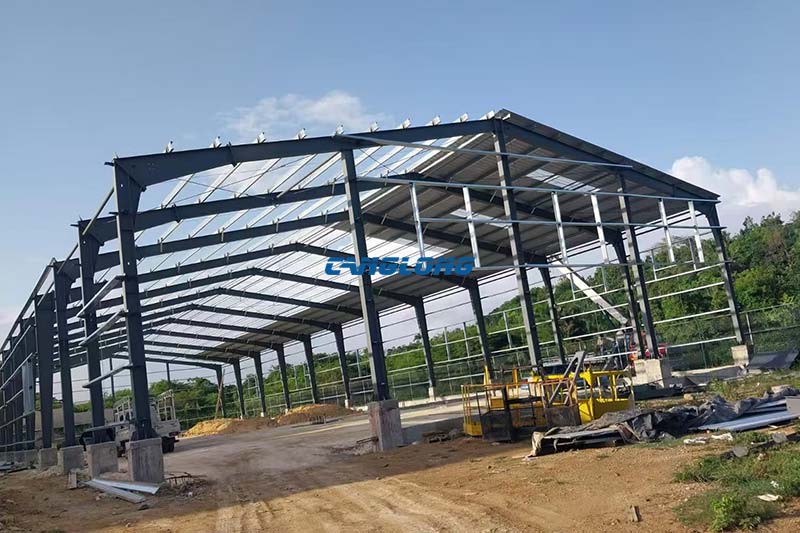
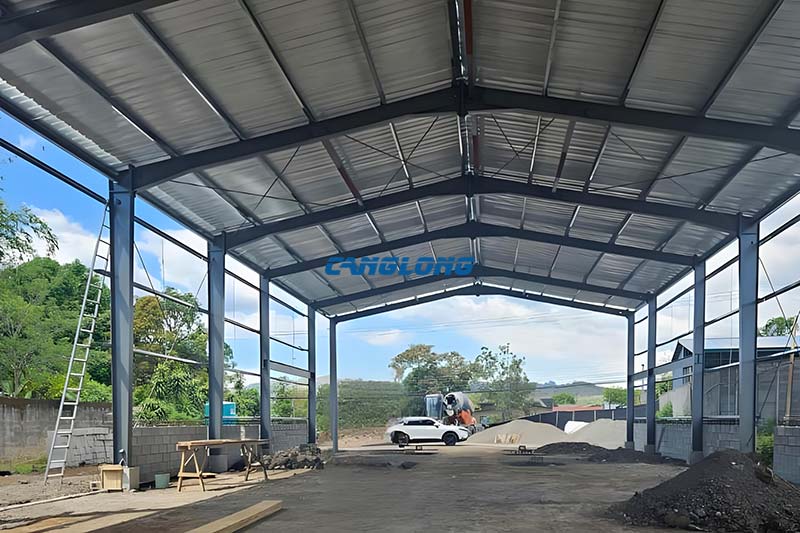
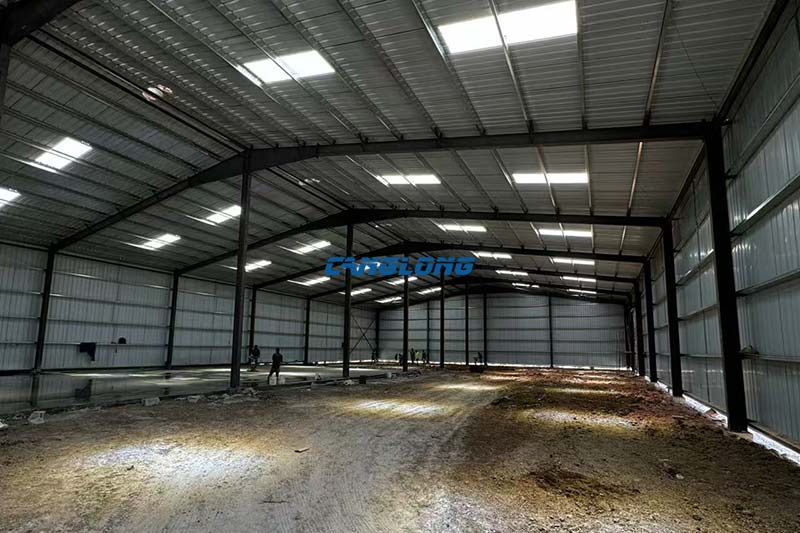
- Pre-assembly is why bolted connections line up the first time. It is a fabrication achievement, not a site achievement — and it is a large part of why a typical 2,000 m² portal frame warehouse can go from prepared foundation to weather-tight in four to six weeks of site erection.
Stage 7: Shot Blasting and Painting — Roughness Is the Point
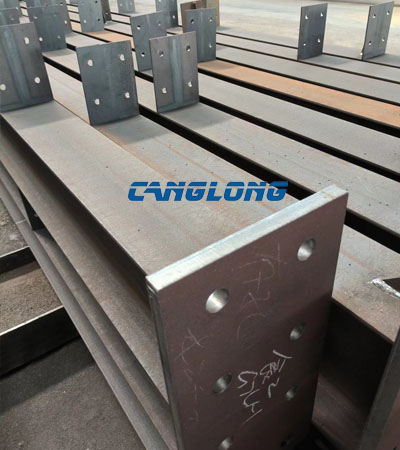
Clients sometimes run a hand over a blasted member and ask why the surface is pitted. That texture is the point. Shot blasting leaves an anchor profile for the paint to grip; a coating applied over blast-cleaned steel lasts far longer than the same coating over mill scale. And the slower the line runs, the cleaner the surface — which is exactly why a coating specification that looks unusually cheap is worth questioning.
Our standard is a three-coat system — rust-inhibitive primer, epoxy zinc-rich intermediate coat, anti-corrosive finish — with film thickness measured by gauge after each coat rather than once at the end.
One detail we treat as non-negotiable: the faying surfaces of bolted connections are masked with tape and left unpainted. Paint inside a slip-critical connection reduces the grip between plate and steel. The bolts need to bite bare metal.
For coastal sites and high-salt environments we move to hot-dip galvanizing instead — we covered what that changes in practice in a seaside hall project in Congo.
Stage 8: Packing, Loading and What Happens After the Paint Dries
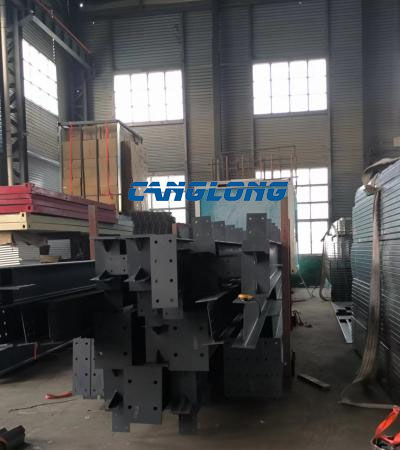
Paint damage in transit undoes the entire surface-treatment stage, so packing matters as much as painting. We offer steel packing racks as an option: members are cradled off the deck so crane slings and forklift tines never touch painted surfaces. Racks are an option, and on most projects they are worth having. Where a shipment goes out without them, we record a loading video so the client can see how the steel was stowed.
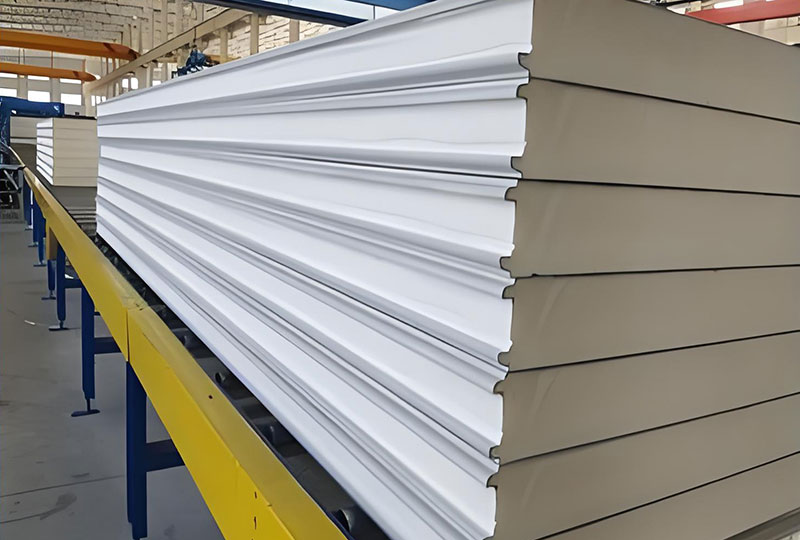
One more thing we tell every client at handover: peel the protective film off sandwich panels as soon as they are installed. The film comes off cleanly on day one. Leave it in the sun for a season and it bakes on, and nobody gets it off without scarring the panel.
The Other Line: Sandwich Panels, Same Discipline
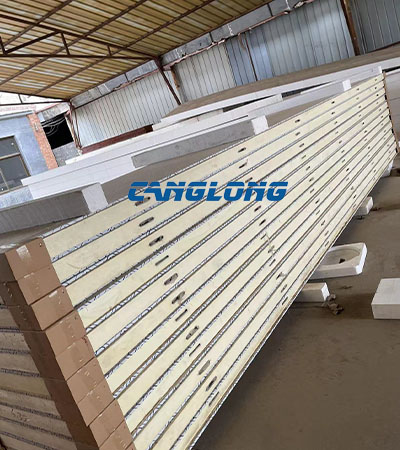
A frame is only half the building. The enclosure line runs in the same production park, and the details are just as specific:
- Panels cool for at least four hours before cutting. Skip the wait and you get bulging and deformation later — usually after installation, when it has become the client’s problem.
- Horizontal panel installation is sun-exposure tested: no blistering, no deformation, with joint cover strips closing the mid-seam.
- Corner panels beat separate angle trims on both appearance and water tightness.
- PVDF coatings are made to order, so a special finish has to be booked into the programme early rather than added late.
- Fibre-cement boards can be supplied asbestos-free. Tell us at order stage so it is specified to procurement from the start.
What This Changes About Comparing Quotations
None of the eight stages above appears as a line item in a quotation. Two offers can carry the same tonnage, the same span and the same delivery week while differing in almost every stage: whether the weld grade is written into the contract, what blast cleanliness grade is actually specified, whether film thickness is measured per coat or eyeballed at the end, whether frames are pre-assembled before painting, whether packing racks exist at all, and whether your tonnage is counted on drawings or on a weighbridge.
That is why we tell buyers to spend less time comparing price per square metre and more time comparing what happens between the cutting table and the container. Our pre-engineered metal building cost guide breaks down what drives price; this post is about what drives whether the price was worth paying.
A Checklist for Your Next Factory Visit (or Video Audit)
| Ask | A good answer sounds like | A warning sign |
|---|---|---|
| Where does the steel come from, and can I see the MTC? | Heat number on the plate matches an EN 10204 3.1 certificate | “Certificates come with the shipping documents” — untraceable steel |
| Which welds are full penetration, and how do you verify them? | Names the joints, offers WPS and inspection records | “All our welds are full penetration” |
| What blast grade and film thickness do you apply? | A specified cleanliness grade, DFT readings per coat in the QC report | “We paint it twice” |
| Do you pre-assemble frames before painting? | Yes — numbered connection plates checked against erection drawings | “Your site crew can adjust on installation” |
| How is the steel packed for shipping? | Optional packing racks; loading video on request | Loose loading to shave transport cost |
Frequently Asked Questions
Can I visit the factory before ordering?
Yes. We encourage buyers to walk the line in person, and we regularly receive third-party inspection companies acting for clients. If travel is not practical, a live video walk-through of the line — including the welding and surface treatment stations — can be arranged.
How long does fabrication take for a portal frame warehouse?
After drawing approval, fabrication of a typical warehouse frame runs a few weeks, with engineering and programming on the critical path before the first cut. On site, a typical 2,000 m² building goes from prepared foundation to weather-tight in four to six weeks, depending on design and site conditions.
Can I specify first-grade, full-penetration welds?
Yes, and you should if the structure demands it — but write it into the order. Verified full-penetration welds take longer to produce and cost more, and they cannot be retrofitted after delivery.
What documents ship with the steel?
Mill Test Certificates for the steel, welding and coating quality records including DFT readings, the packing list, and erection drawings matched to the part numbers on the members.
Paint or galvanizing for a coastal site?
For high-salt, high-humidity environments we generally recommend hot-dip galvanizing of the primary and secondary steel. The Congo seaside project linked above shows what that looks like in practice.
Talk to the People Who Run the Line
If you are planning a steel warehouse building, send us the span, length and eave height, the project location and intended use, plus any crane or racking loads. Our engineering team will confirm the applicable design code and come back with a preliminary layout, a steel quantity estimate and a quotation — the quotation is backed by everything you have just read about the line that will cut, weld and coat it.
As a well-known steel structure construction supplier in China, Canglong Group has 20 years of industry experience and provides one-stop steel structure solutions from design to installation. We have a factory of 100000 square meters, and all our products have been certified by ISO and CE, and are sold to over 80 countries and regions worldwide.
Related Posts
 March 12, 2026
 May 8, 2026
 September 15, 2025
 March 19, 2026
Leave a Message
Your email address will not be published. Required fields are marked *
 September 7, 2026
 August 20, 2026