 2026-11-05
By
 Canglong Group
22
Indoor vs Outdoor Pickleball Courts PH
Decision Guide · Philippines
One decision comes before the court count and the budget: does the court go under a roof, or does it stay open?
We supply the steel for covered courts, so our answer is worth taking with that in mind. This page is our honest version of it, including the cases where building covered would be the wrong call.
The Short Answer
An outdoor court works. It costs much less to build, and in the dry months it plays perfectly well. Its problems are seasonal and maintenance:
- Rain closes the court, and it stays closed for an hour or two after, while the surface dries.
- Sun and rain wear the surface out. Paint contractors in the Philippines commonly quote a resurfacing every two to three years for outdoor courts; under a roof the interval is much longer. Confirm the numbers with your own surfacing contractor.
- Wind, heat and wet patches change how the game plays.
- Light poles, fencing and nets take the wind in every typhoon.
A covered court removes all four problems and adds two of its own: a much higher build cost, and electricity for lights and fans.
That is the trade in one paragraph. The rest of this page is about the details people usually get wrong.
What the Rain Actually Costs
Most of the country gets heavy rain from June to November, and afternoon showers in the other months too. The rain itself is only half the problem. An acrylic court holds water in its low spots and needs sun to dry. So a morning shower writes off the morning, and a 3 pm shower writes off the evening.
The second cost is harder to see. Players book an outdoor court the way they plan a trip to the beach: by looking at the weather. A venue that cannot promise playing conditions cannot take bookings weeks in advance. If your income depends on booked hours — leagues, clinics, school programmes — this is the first number to check. Ask anyone who runs an outdoor court in your city how many days a year they lose. They will know.
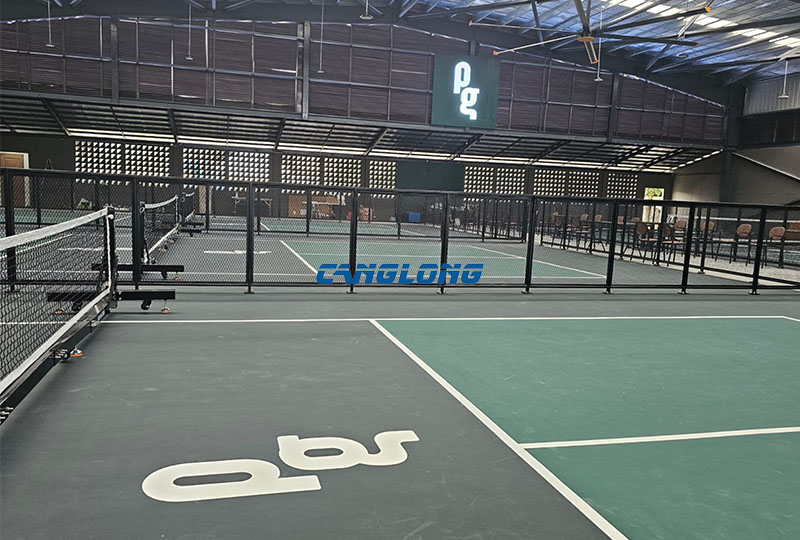
For our six-court venue in Cebu, this was the client’s reason for building covered: they run leagues and school programmes on a fixed weekly schedule, and an open court cannot support that.
When an Outdoor Court Is the Right Choice
Outdoor is not a compromise; in these cases it is simply the right answer:
- The court is an amenity, not a business. For a subdivision, school, resort or barangay court, it earns value even at low utilization. Nobody’s lease depends on bookings.
- Budget is the limit. An open court costs a fraction of a covered one, and courts get people playing.
- You are testing demand. Open courts are a reasonable first step — with one condition, explained in the next section.
- Your area is dry. Some parts of Mindanao and eastern Cebu have shorter, more predictable wet seasons than Manila or Iloilo.
If the venue’s business model is selling booked court-hours, the trade-off usually goes the other way. Hours lost to rain and drying are hours you cannot sell, and the shorter resurfacing cycle repeats every few years.
About Tarp Roofs
Between open court and steel building sits the tarp roof: a fabric canopy on a steel frame. It is common in the Philippines for a simple reason. One contractor publishes planning figures of about ₱1.6M–2.5M for a two-court tarp setup, against ₱2.7M–3.7M with a metal roof. The saving is real.
Three things to know before choosing it:
- The fabric does not last. Plan on replacing it every few years, and each replacement means scaffolding and a closed court.
- Typhoons damage fabric first. A torn tarp over an acrylic court leaves you with the same water problem you started with.
- Fabric holds heat. On a clear April afternoon, a court under translucent fabric can feel hotter than an open court with a breeze.
Our view: for a commercial venue in a high-wind zone, we would not recommend it. For a low-budget trial site in a calm area, it can be a reasonable first step.
Why “Cover It Later” Rarely Works
Many owners plan to build open courts first and add a roof when the business grows. In practice this almost never works, for one simple reason: a roof needs columns, and columns cannot stand inside a court’s run-off area.
Open courts are laid out with wide, even spacing because nothing interrupts them. A covered building needs its columns on fixed lines — at the walls and along the walkways between courts. An outdoor layout almost never happens to match those lines. Retrofitting means new footings squeezed between courts, odd leftover spans, and a cost that is usually higher than building the structure properly the first time.
If you think you will want a roof one day, plan it now. The practical approach is to fix the span for the largest court count you might ever run, and build the length of the building in stages. We walk through that with numbers in our article on court counts.
Five Questions to Settle It
- Is the court a business or an amenity? A business that sells booked hours needs a roof.
- How many days a year does rain close an outdoor court in your city? Ask the people already running one.
- Can the budget carry the building and the running costs? Lights and fans use electricity every session.
- Will you want more courts in three years? If yes, decide the span now — see the point above.
- What wind zone is your site in? Under NSCP 2015, Zone 1 sites (250 kph) are the hardest on light structures and fabric.
Frequently Asked
How much more does a covered court cost?
Significantly more than an open court, but published per-square-metre figures vary widely because they cover different scopes. Our cost article explains what those figures usually include and exclude. The number that matters is the one from your own quotes, compared on the same scope.
Does a covered court cost more to operate?
Yes. Lights and ventilation fans use electricity that an open court does not. Against that: fewer resurfacing cycles, no typhoon repairs to poles and fencing, and playable hours in every month of the year. For a booked-revenue venue the covered building usually comes out ahead. For an amenity court, it may not — run your own numbers.
Can I add a roof over my existing outdoor courts?
Technically yes, economically usually no. The columns a clear-span roof needs will not fit an outdoor court layout. If covering later is the plan, design the building frame from the start and extend it in phases.
Is a tarp roof a good compromise?
For a low-budget trial in a calm area, it can be. The fabric has a limited life, it is the first thing a typhoon damages, and it holds heat. If the venue depends on uptime, the fabric gets paid for more than once.
Do you recommend indoor or outdoor?
We supply covered courts, so weigh this accordingly: if the venue depends on booked revenue, cover it. If it is an amenity for casual play, an outdoor court is a sensible answer, and the money saved can go toward the land for a covered hall later.
Next Step
If you are leaning covered, the useful next step is not a quote — it is a layout. Send us your lot dimensions and the court count you have in mind, and we will come back with a span recommendation and a steel quantity.
Send Us Your Lot Size
Lot dimensions, city and target court count are enough to start. You will get a layout and a steel quantity, not a brochure.
Related reading
- Pickleball court steel building — spans, ventilation and code paths for covered venues.
- Six-court venue in Cebu — the delivered project mentioned above.
- Portal frame steel structure — the frame system used in covered courts.
As a well-known steel structure construction supplier in China, Canglong Group has 20 years of industry experience and provides one-stop steel structure solutions from design to installation. We have a factory of 100000 square meters, and all our products have been certified by ISO and CE, and are sold to over 80 countries and regions worldwide.
Related Posts
 April 1, 2026
 August 1, 2025
 November 5, 2026
 February 26, 2026
Leave a Message
Your email address will not be published. Required fields are marked *
November 5, 2026
 September 30, 2026