



 October 16, 2026
 September 30, 2026
 September 7, 2026
Armenia Equipment Warehouse
Project Case Study · Yerevan, Armenia
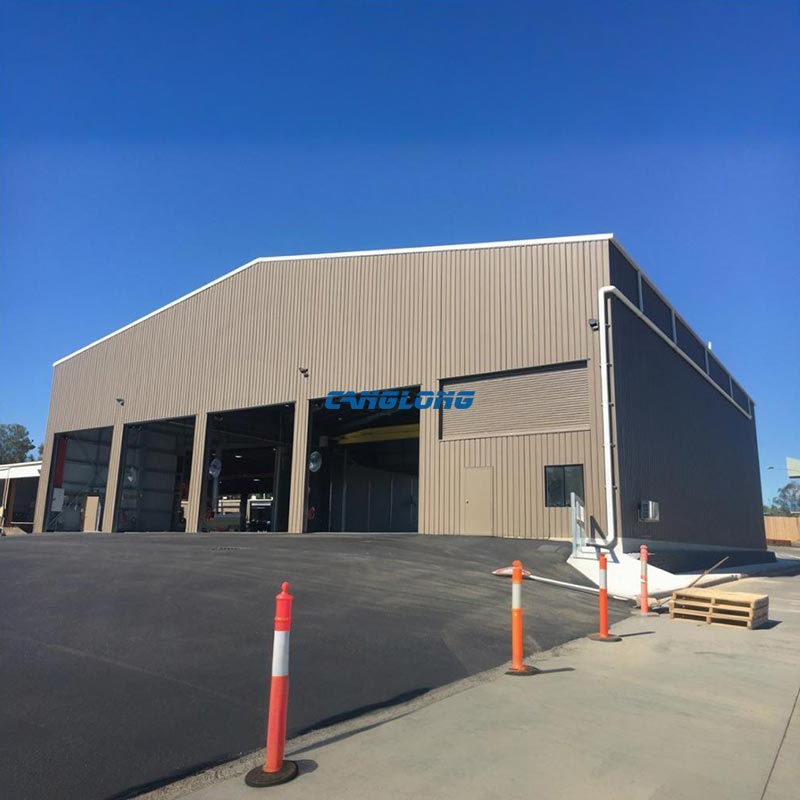
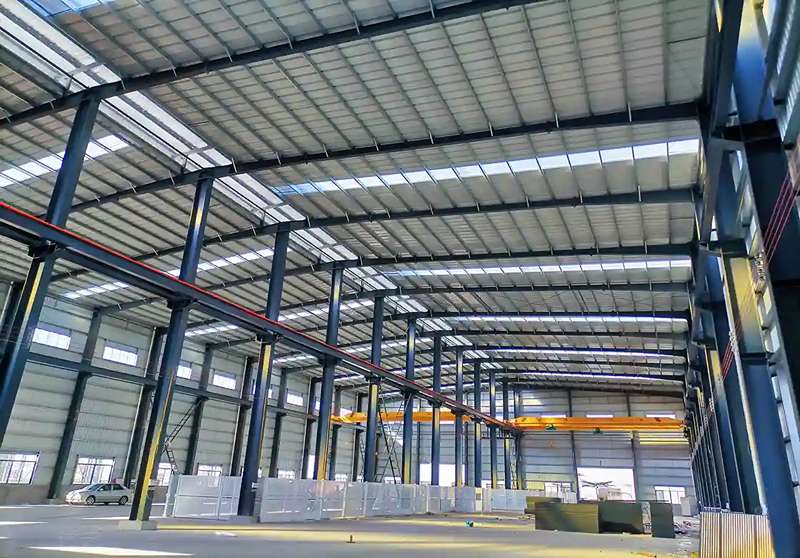
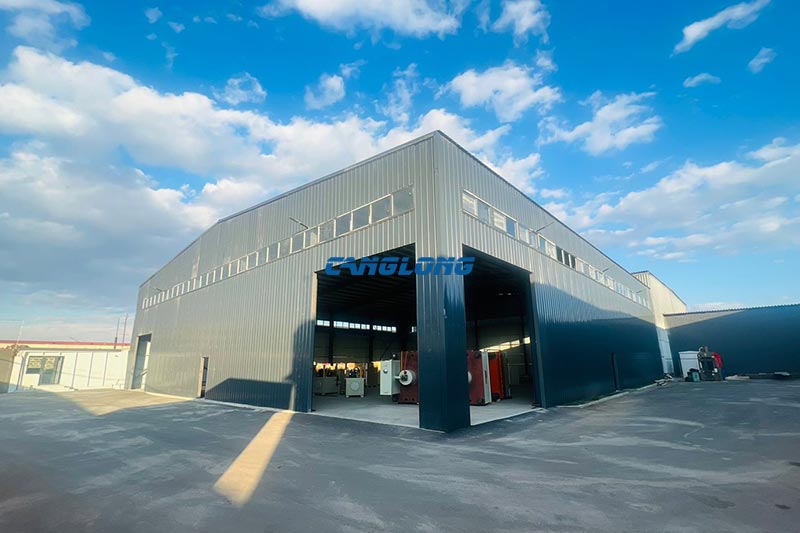
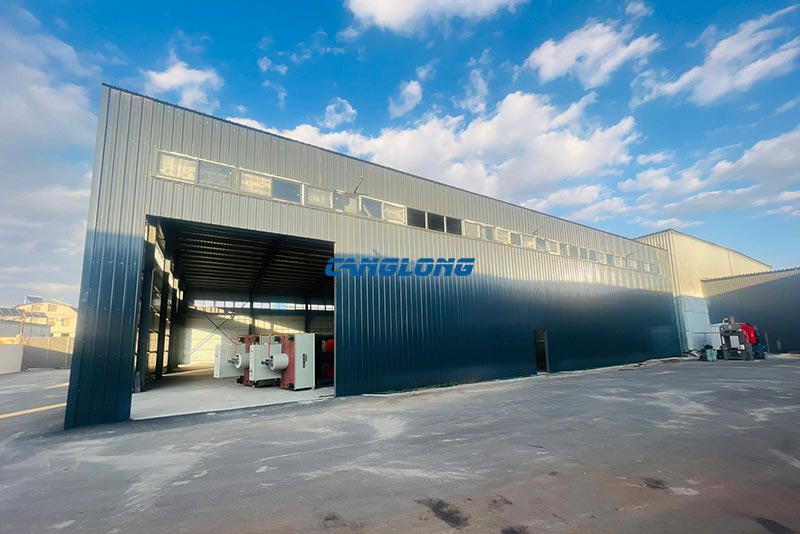
This 960 m² equipment warehouse in Yerevan does two things that normally work against each other: it spans thirty metres with no center column anywhere on the floor, and it carries a 5-ton overhead crane on runway beams hung off the same columns that make the clear span possible. The frame is welded Q355B H-section, the whole package came in at roughly 52 tons of steel — about 54 kg per square metre for span, crane beams and all — and the envelope is dark grey color-steel sheet on both roof and walls, vented by wind-driven roof turbines and a continuous band of strip windows.
The thirty-metre span is the part worth understanding. A center column would have halved the rafter depth and cut the steel tonnage; the client paid for that column not being there, because an equipment warehouse with a crane living in it needs every line of the floor plan clear. This page sets out what that decision actually costs, what the crane does to the frame, and which numbers you need before anyone can quote you a similar building.
- Location: Yerevan, Armenia
- Building: Equipment warehouse
- Span: 30 m, no center column
- Crane: 5 t runway beams
- Envelope: Dark grey color-steel
960 m²
Floor area
30 m
Clear span
8 m
Eave height
5 t
Crane capacity
52 t
Steel consumption
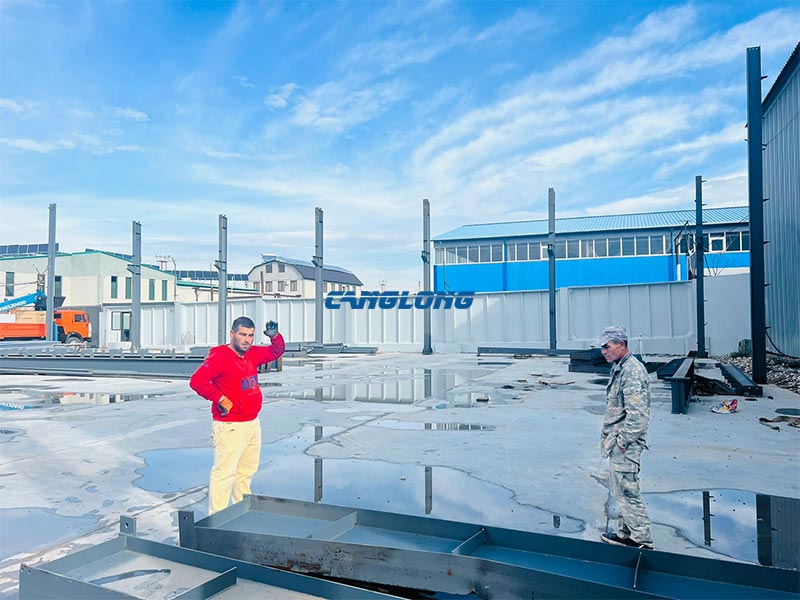
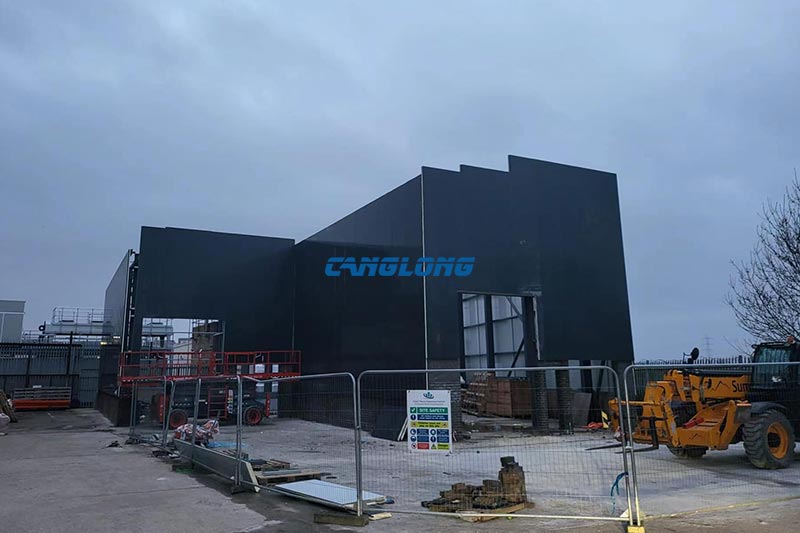
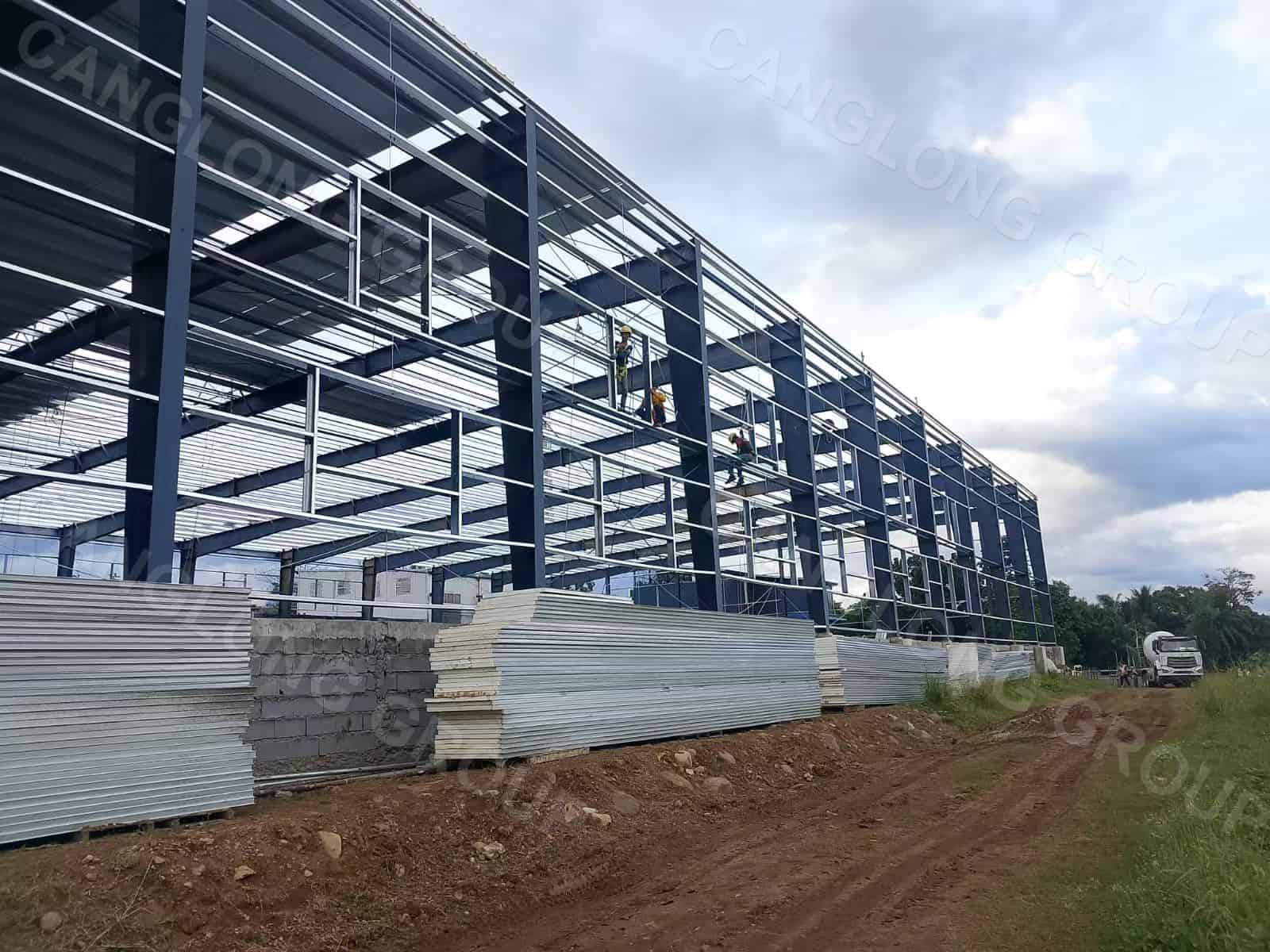
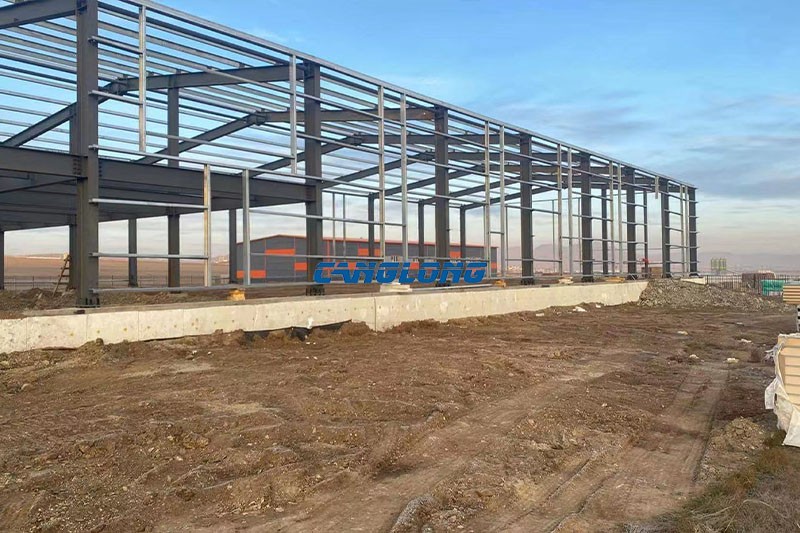
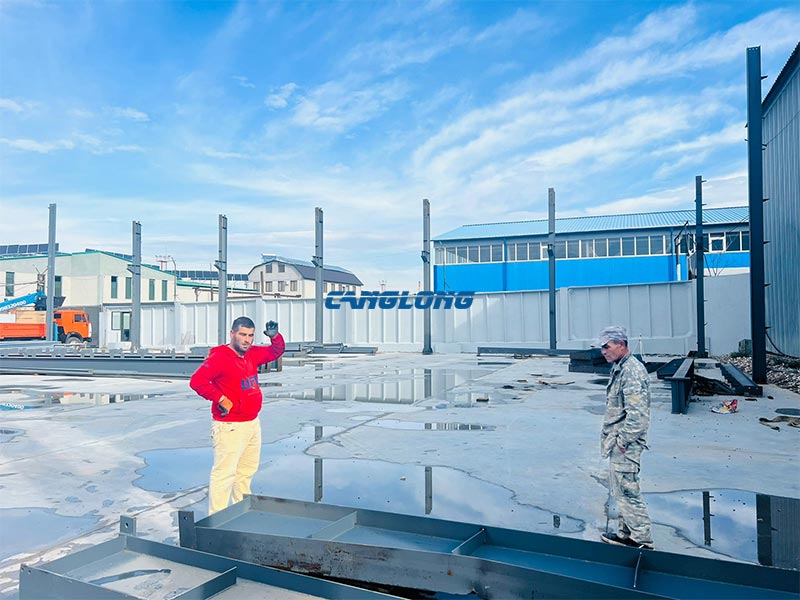
Erection on a wet Yerevan slab: dark grey painted H-section members in the foreground, the first columns standing on the left, cladding sheets stacked against the hoarding. The deep welded beams on the ground are the ones the crane runway hangs from — the members that decide whether a crane building behaves.
Project video — the Armenia equipment warehouse.
Five Inputs Before Anyone Can Quote a Warehouse Like This
A clear-span crane warehouse is one of the few building types where two buyers asking for “the same thing” can land twenty tonnes apart in steel weight. Five inputs decide which one you get, and a supplier who quotes without them is guessing.
1. The span — and whether a center column is truly off the table. Thirty metres clear is a genuinely different frame from two fifteen-metre bays: deeper rafters, heavier haunches, more steel in the eaves connection. On this project the client chose the clear floor deliberately, and knowing that choice was fixed let the frame be designed once, correctly, instead of priced twice.
2. The crane data — capacity, duty class, hook height and runway length. “5-ton crane” is the start of the conversation, not the end. The crane’s duty class sets the fatigue and surge allowances, the hook height sets the eave height, and the runway length sets how many columns carry the wheel loads. On this building the answers produced 8 m eaves and runway beams on every internal frame column.
3. The site’s snow and wind figures. Yerevan sits at roughly 1,000 m above sea level, and much of Armenia sits higher; winter snow load is a real design input here, not a formality. The load numbers come from the site, not from us — and they size the purlins, the roof bracing and the rafter as directly as the span does.
4. The eave height, from the equipment down. Eight metres here is not an aesthetic choice; it is the tallest stored item plus the crane hook travel plus the clearance the hoist needs to park under the roof. Setting eave height from the process, rather than from a catalogue page, is what keeps a crane building from being rebuilt on paper halfway through.
5. Whether the hall will ever be heated. This decides the envelope more than any other question. This package is a single-skin color-steel envelope — the right build-up for an unheated storage hall, and the wrong one for a workshop where people work at benches in January. Say which building yours is before the cladding is priced.
Thirty Metres Without a Column — and Then They Hung a Crane on It
The clear span gets the compliments, but the crane is what actually shaped this frame.
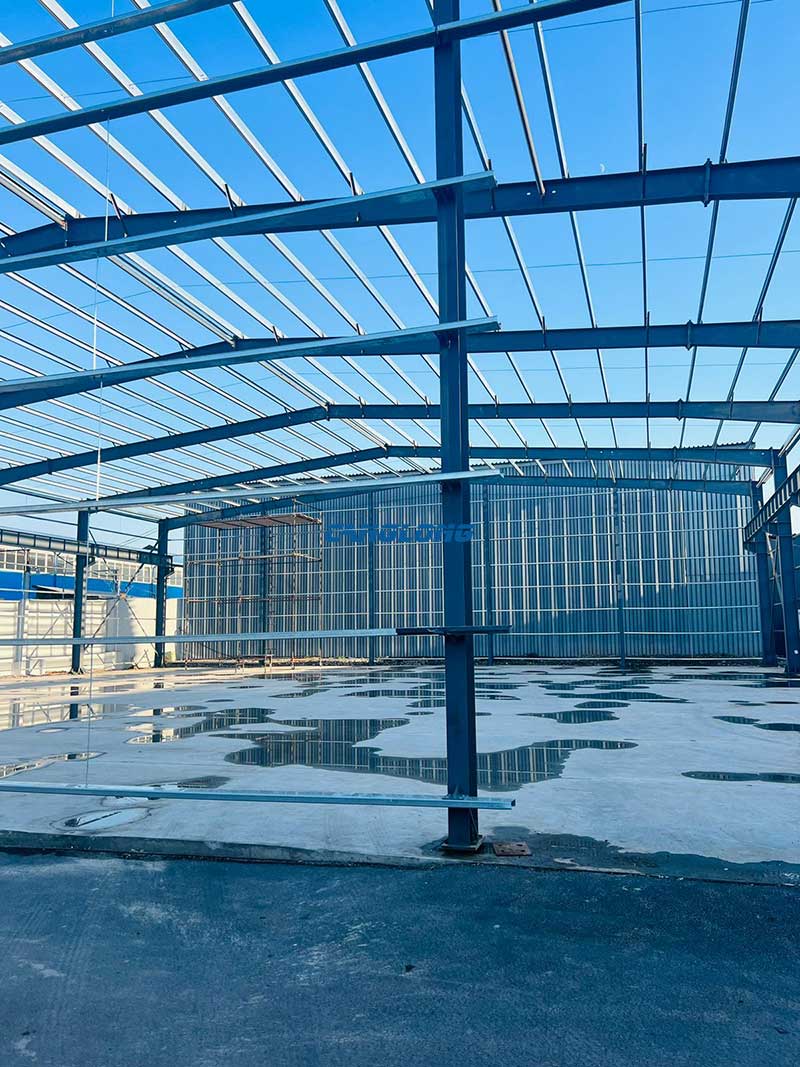
What the clear span bought. With no column line at 15 m, the floor works end to end: forklifts turn across the full width, equipment sets where the process wants it, and the next re-layout costs nothing in concrete to demolish. The price of that is structural, not cosmetic — two 15 m spans would have let the rafters run at roughly half the depth, so every metre of clear span is steel the client chose to buy on purpose.
What the crane does to the columns. The runway beams sit on brackets off the portal columns, which means the crane’s wheel loads, its transverse surge when the bridge brakes, and the eccentricity between beam and column centreline all land on the members that were already the most highly stressed in a 30 m frame. In a crane building of this span the columns govern the design — not the rafters, which surprises most buyers. That is also why crane buildings are quoted frame by frame rather than per square metre: two warehouses with identical footprints can differ by a third in steel weight if only one of them carries a crane.
What the numbers came to. Roughly 52 tons of steel across frame, purlins, bracing and both runway beams — about 54 kg/m² over the 960 m² floor. As a rule of thumb, a 30 m clear span carrying a 5 t crane at 8 m eaves lands in the 50–60 kg/m² band; a quotation far under that is usually missing bracing or has drawn the runway detail on hope. Q355B is the sensible steel grade here: at this span the higher yield strength buys stiffness where it matters instead of tonnage everywhere.
Dark Grey Sheet, Roof Turbines and a Window Band That Works for a Living
The envelope is dark grey color-steel sheet on both roof and walls, and it is worth being honest about that colour choice, because most spec sheets will not be.
The honest cost of dark cladding. A dark grey roof runs hotter under a July sun than a light one — that is physics, not opinion. The client chose the colour for how the building sits on its site, and the ventilation package is what makes the choice workable: heat that a dark roof adds has somewhere to go. What we will say plainly is that on a hall where summer internal temperatures are process-critical, we would push a lighter roof and spend the colour budget on the walls, which do not carry the sun at the same angle all day.
The wind-driven roof turbines. No power, no wiring, no running cost — they pull air out of the ridge zone whenever wind moves or the hall runs warmer than the street. Their honest limit is still days: in dead calm they extract very little, which is why they are sized as the second ventilation path, not the only one.
The strip windows. A continuous band of long windows runs the elevation, high in the wall: daylight down the working aisles through the day, a stack-ventilation outlet near the roof line, and a break in what would otherwise be thirty-two metres of uninterrupted grey. Between the turbines pulling at the top and the window band feeding air at working height, the hall moves air without a single fan on the electricity bill — which is the “double effect” the client asked for, stated in terms a design reviewer can check.
Snow, Wind and Earthquake: What the Armenian Site Demands
Armenia’s highland continental climate and its seismicity are the two site facts that no amount of steel generosity can design around after the fact — both have to be in the calculation from the first sketch. The double-slope roof here is pitched to shed snow rather than store it, the roof and wall bracing carry the plateau’s seasonal winds, and the rigid Q355B portal frame is calculated to the local seismic requirements rather than to a generic default. Canglong supplies the full structural calculation report, fabrication drawings and material certificates with the package, so the client’s local engineer or building authority can review every number independently — which on a seismic site is not a courtesy, it is how the delivery should work.
The Project at a Glance
| Building type | Single-storey equipment storage warehouse, rigid portal frame |
| Location | Yerevan, Armenia |
| Dimensions | 30 m clear span × 32 m length × 8 m eave height, 960 m² floor area |
| Frame | Welded Q355B H-section columns and rafters, rigid connections, no center column |
| Crane provision | Runway beams for a 5 t overhead crane, carried on column brackets |
| Steel consumption | ≈ 52 t total, ≈ 54 kg/m² including runway beams |
| Cladding | Dark grey color-steel sheet, roof and walls, single-skin envelope |
| Ventilation | Wind-driven roof turbines plus continuous strip window band |
| Canglong scope | Structural design, fabrication and supply of frame and envelope, calculation reports and erection drawings |
| Outside our supply | Foundations and civil works, the crane hoist itself and its electrification, internal services |
| Handover | 2024 |
Where this specification would be the wrong answer. If the hall will be heated through an Armenian winter, a single-skin dark grey envelope is the wrong build-up — it will condense on the underside in January and bleed heat you are paying for; that building wants sandwich panels, and the decision belongs on the first drawing, not after the first winter. If the crane fleet may grow past 5 t later, think hard now: the runway beams and column brackets are engineered to the crane class, and upgrading later means new columns, not new beams. And if the process inside generates real heat or humidity, wind-driven turbines will not carry it alone — that is a job for powered extraction sized to the process, not for whatever the roof looks good with.
The Review From Our Side
Our export consultant on this project was Sophia Liu. Her account of it:
The client wanted the full thirty metres with nothing in the way, and a 5-ton crane over it. We hung the runway beams on the columns and kept every square metre of that floor working. Dark grey sheet on the roof and walls, turbines on the ridge, the window band down the elevation — it moves air and it looks right doing it.
— Sophia Liu, Export Consultant, Canglong Group
Questions Buyers Ask About This Project
Can you design for Armenia’s snow loads and seismic requirements?
Yes — the frame is calculated to the site’s snow, wind and seismic inputs, not to a regional default, and the delivery includes the full structural calculation report, fabrication drawings and material certificates so your local engineer or building authority can review everything independently. Third-party engineering review is a normal part of our European deliveries, and on a seismic site it should be non-negotiable whichever supplier you choose. The wider checklist for storage halls — from floor loading to ventilation strategy — is on our industrial warehouse applications page.
Is the 5-ton crane included in the package?
The runway beams, brackets and connections that carry the crane are part of our structural scope; the hoist itself and its electrification sit outside it and are procured locally or separately. To design the runway correctly we need the crane’s capacity, duty class, hook height and total wheel loads — “5 tons” alone is not enough data, and a supplier who quotes from it alone is guessing at your columns.
Doesn’t a dark grey roof overheat the building?
It runs hotter than a light roof in direct sun — that is real, and we say so rather than pretend colour is free. On this project the client chose dark grey for how the building sits on its site, and the ventilation package (ridge turbines plus the high window band) gives the added heat a way out. Where internal summer temperatures are process-critical, we recommend a lighter roof and put the dark grey on the walls instead.
How long does a 960 m² warehouse take from order to delivery?
Design and fabrication typically run four to six weeks after order confirmation depending on specification, and sea freight to the region adds roughly three to five weeks. The span-and-crane combination matters more to the schedule than the floor area does — a 960 m² shed without a crane is a simpler frame than this one, and the runway details are where crane buildings earn their extra weeks. More on how span, crane and cladding interact is on our portal frame warehouse page.
About Canglong
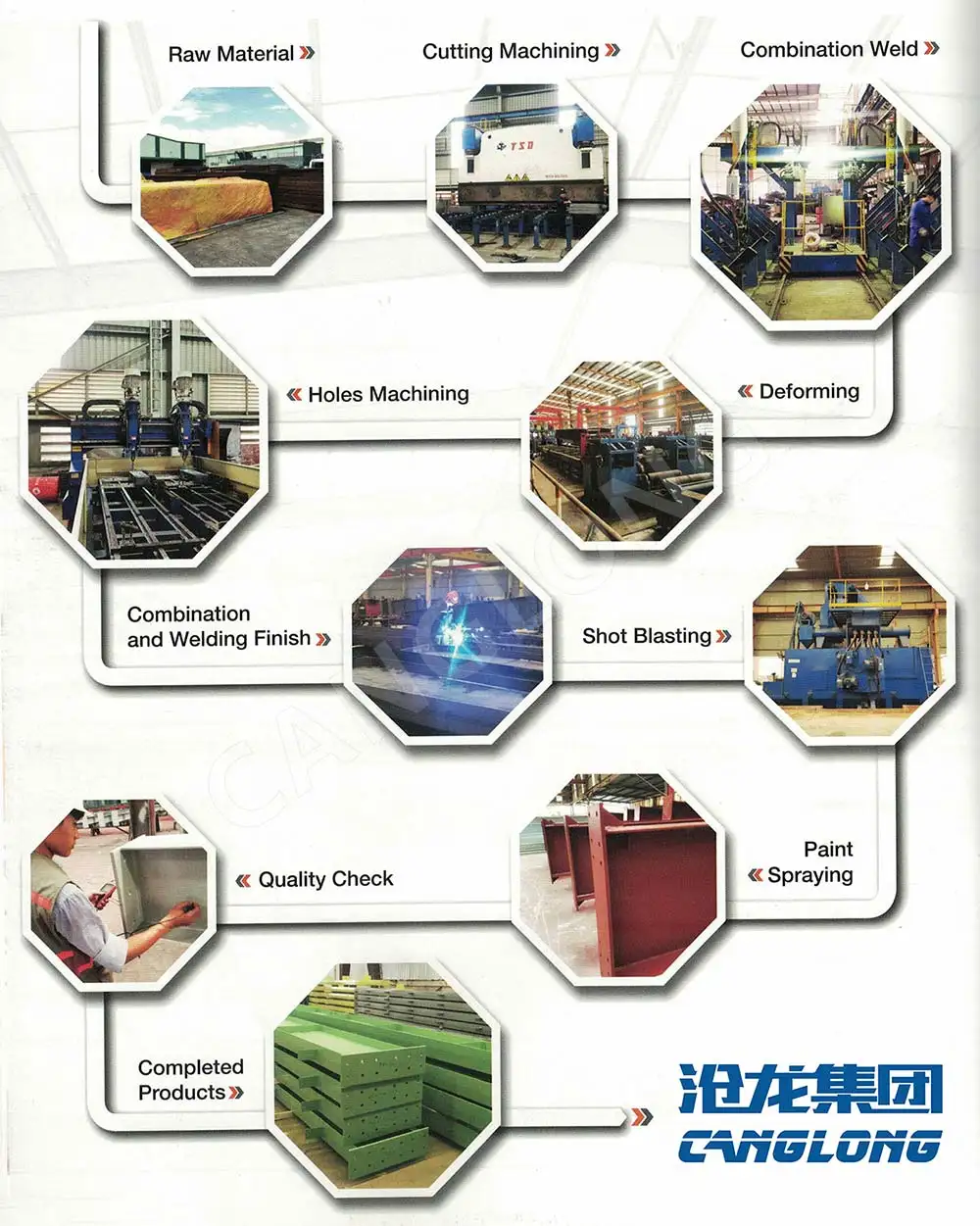
Canglong Group is a steel structure manufacturer and exporter with two decades of design and fabrication experience, supplying buildings to more than 80 countries. Clear-span crane buildings like this one — frame, runway beams, purlins and cladding engineered as one package — run through our own works, so the columns, the brackets and the beams they carry arrive on one drawing set instead of three.
More about the company, the production process and certifications is on the About Canglong page.
Planning a Clear-Span Crane Warehouse?
Talk to Sophia About Your Project
SL
Sophia Liu
Export Consultant · Canglong Group
Export Consultant · Canglong Group
Send her five numbers — the span and the column question, the crane data, your site snow and wind figures, the eave height from your tallest equipment, and whether the hall will ever be heated — and the quote comes back engineered, not estimated.
Related pages
- Portal frame warehouses (15–36 m clear span) — how span, crane class and cladding interact frame by frame.
- 7,228 m² industrial plant in Bangkok — the heavy-crane version: two 20-ton cranes on a double-span frame.
- Steel warehouse in Hungary — another European delivery where the site climate set the envelope.
Project Info
Country
Armenia

Project Name
Equipment Warehouse
Project Date
2024-3-12
Product Address
Yerevan, Armenia
Area
960㎡
Customer Reviews
10.612 Rating
Quality
5.0
Price
4
Design
88
Service
91
Delivery
83
Package
75
Project Details
No
Contact us Leave a Message
Your email address will not be published. Required fields are marked *
Bringing the steel building to you
Figure out what you want, choose the type of building you need, understand the cost, contact Canglong then go get it!